Stafford Consulting · Small business
Structure underneath. Growth above.
The structure underneath your business, so you can stop being the system. We see how the work actually moves, set it on structure you own, and keep it running on a steady rhythm. Nothing about your day changes — everything underneath it does.

01 Before / afterNothing about the day changes. Everything underneath it does. · Click to open full size
Is this for you?
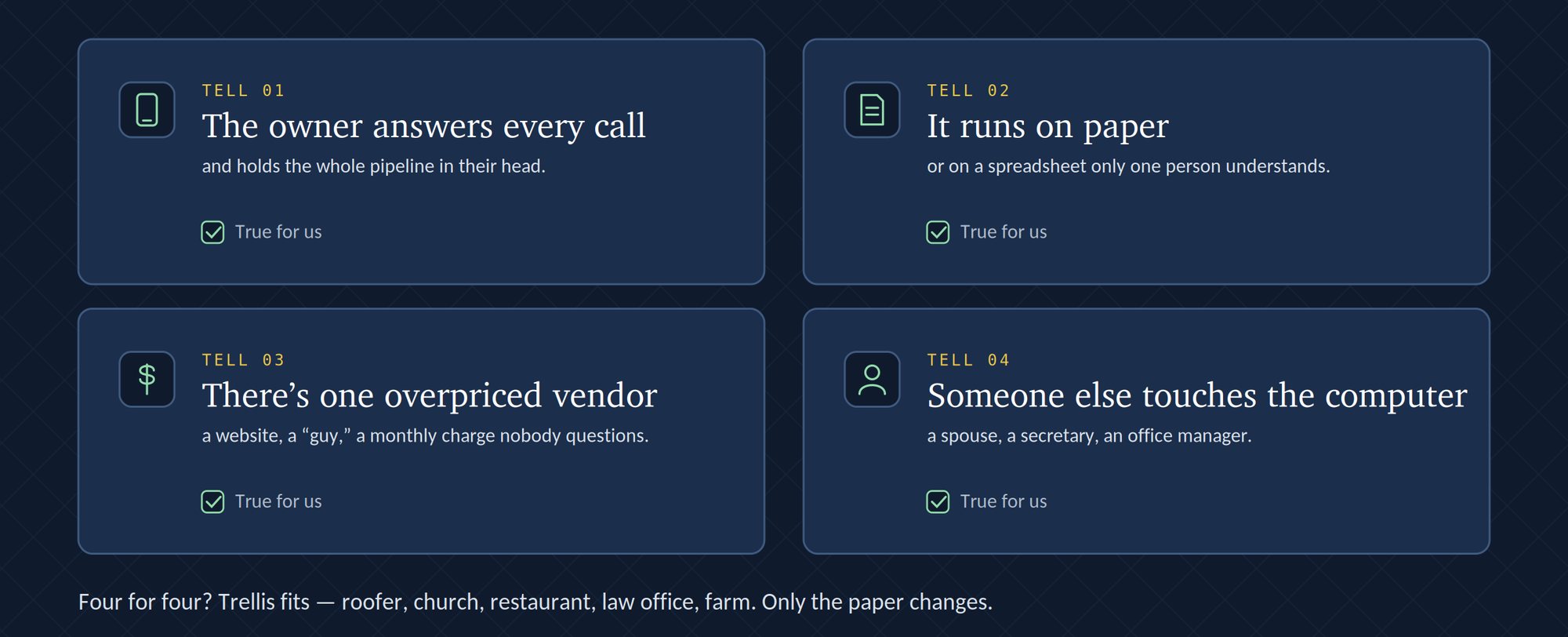
Roofer, church, restaurant, law office, auto shop, farm. Only the paper changes. If two or more of these are true for you, Trellis was built for your desk.
Tell 01
Customers, suppliers, the insurance adjuster, the guy about the truck. If you don’t pick up, nothing moves.
Tell 02
You know what’s open, what it’s worth and who to call back. Nobody else does — and nothing is written down where they could look.
Tell 03
The estimate pad, the work order, the intake card. Or a workbook only your office manager understands.
Tell 04
A marketing outfit, a “website guy,” a listing service. You’re not sure what it does — or who owns what they built.
And usually there’s a spouse, a secretary or an office manager who’s the one who actually touches the computer. That’s who we work with.
How it works
No new software. No new habit. We find the form you already fill out and make it leave a trail.
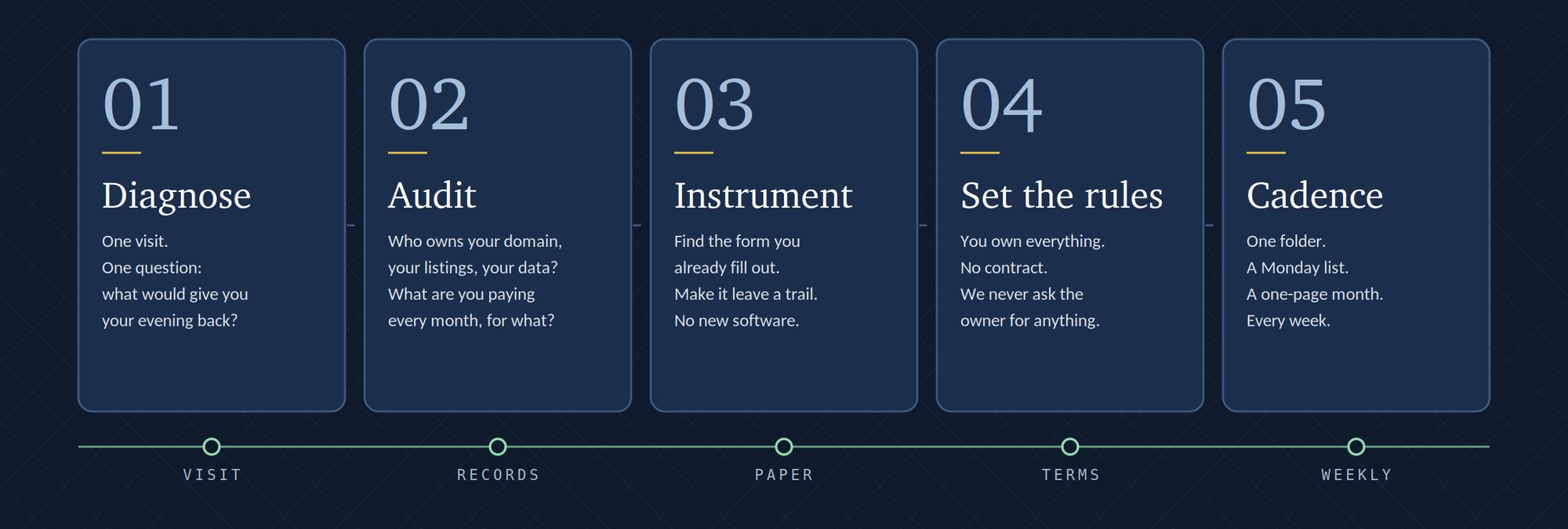
We start by looking. How a job actually moves from first contact to final payment, and where it stops moving — every business has one place the whole thing waits on. Plus one question: what would give you your evening back?
A full discovery pass: who owns your web address, your listings and your data, what you pay every month and for what, and which step is quietly holding up the rest. This is where most owners find out something they didn’t know.
The estimate, the work order, the intake — whatever your business already runs on, paper or screen — made to leave a trail. Nothing new to learn.
You own everything. No contract. We never ask you for anything — we ask your office, or we come and get it.
A standing rhythm that fits your business: a running list of what’s open, what it’s worth and who needs a call, on a schedule you set. A one-page month.
The diagnostic is free · you keep the findings sheet either way
The point of the audit
Work does not slow down evenly. It backs up in one place — the quote that waits on you, the invoice nobody sends until Friday, the call that only you can answer. Everything downstream inherits that delay, and because it is the same delay every week, it stops looking like a problem and starts looking like the job.
We walk the whole path a job takes — first call to final payment — and time each handoff. Not a survey and not a guess: the actual steps, in order, with the wait built in. The chokepoint is wherever the work piles up waiting on one person or one decision, and it is almost never where the owner expects.
Once the records leave a trail, the business starts telling you things: which jobs stall and where, what a lead is actually worth, which week you overbooked, what you are paying for and not using. That is the signal. We route it back to the place decisions get made — a short standing report, not a dashboard nobody opens — so next month is set by what happened last month instead of by memory.
Fix the chokepoint and the whole line moves · that is the entire job
What the rhythm looks like
The loop is the whole service seen from your side of the desk. Your records are captured where the work happens. We collect and log them. You get one list of what needs you. Then it starts again.

Every estimate, work order or intake you complete is captured where you already work — paper or screen. That’s the whole habit.
On a schedule that fits your business we gather it — from your office, never from you — and every record is logged, dated and filed under the customer.
What’s open, what it’s worth, who to call. One page, on your desk or in your inbox before the day starts.
Quoted, won, lost, waiting, paid. Listings checked. The service invoice goes out with it — no card on file, nothing that auto-charges.
The rules
RULE 01
Your domain, your files, your listings, your customer list — in your name, in your accounts, on your card. We hold access to do the work.
RULE 02
You can shut off our access in two clicks and nothing of yours moves an inch. If you ever leave, we hand you the whole thing and help you move it.
RULE 03
Not a password, not a photo, not a signature on a Tuesday. We ask your office, or we come and get it. Your evenings are the point.
A trellis belongs to the gardener, not to whoever built it. Everything Trellis sets up — the records system, the templates, the logbook, the website, the listings — is titled to you from day one. If you stop after the cleanup, you keep all of it. That is not a courtesy; it is the design.
What it costs
We won’t promise you leads or rankings. We’ll make sure what you already pay for is yours and is working.
We don’t answer your phone, run your customer relationships, or touch your money.
When something in a contract needs a real opinion, we’ll say so and point you to one.
The work runs on a schedule, so you always know when to expect it — and so do we.
The brand kit
A trellis does nothing on its own. It doesn’t grow, doesn’t produce, doesn’t get the credit — the plant does all of that. Without it, half the growth is wasted on the ground.



The vine is the client. The lattice is us. The gold is where the two touch — the records and the list.
Wordmark in Charter, labels in Carlito. Never bold the wordmark, never set it in a sans, never put the lattice on a photo. The mark also carries the ownership rule: a trellis belongs to the gardener, not to whoever built it. Full brand guide, trademark notes and print-ready files are in the Trellis kit.
Builder’s tools
Both stand on their own, outside the Steward™ suite. Plumbline records what a household is worth and where each figure came from. Trellis holds up the business that produces it. Neither claims the other’s job.
FAQ
No. Trellis is built on the form you already fill out. If you use an estimate pad, you keep using the estimate pad. The trail is added underneath it.
That’s the first thing the audit looks at: what you pay, what it does, and whether the domain, the listings and the site are actually in your name. Often they aren’t. We fix the ownership first; whether you keep the vendor is your call.
Your office — a spouse, a secretary, an office manager, whoever touches the computer. Never you, unless you want to. That’s a rule, not a preference.
You keep everything. It was all in your name from the first day. We remove our own access, hand you a one-page map of where everything lives, and help you move it if you want to.
No. The first Trellis engagement was a roofing company, but the method is about the shape of the business, not the industry. A church office, a restaurant, a law practice, a farm stand — only the paper changes.
Not yet. Trellis™ is used in commerce by Stafford Consulting under common-law rights; the mark and method are original work. That’s why the ™ and not the ®.
Structure underneath. Growth above.